
Springs on a Reformer Bed
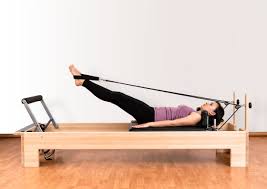
A reformer is a bed-like frame with a dynamic flat platform, called the carriage, that rolls back and forth on hidden wheels within its frame. A set of springs on one end of the reformer determines how easy it is to move the carriage. There are many different spring configurations available, each offering its own unique feel and resistance. Adding a spring increases resistance while removing a spring decreases resistance. The combination of the body weight of the practitioner and the spring choice creates a “personality” for each reformer bed, and it is therefore important to choose the right set-up for your client.
The reformer is a fantastic piece of equipment that allows us to stretch and strengthen the body from every angle, whether we’re lying down, sitting, standing or kneeling on all fours. It is the perfect piece of equipment to challenge all the major muscles of the body, including the deep stabilising muscle groups. Its moving carriage and variable spring setting makes it a highly versatile exercise tool that can be used for a variety of Pilates exercises, both pushing and pulling the carriage.
When working with the springs on a Reformer, it is important to remember that they are there to support you. Often the incorrect assumption is that adding more springs or a heavier set of springs will automatically make a workout harder. This is not always true; it all depends on the individual, and how much strength and control are required to move the carriage. For example, a heavy set of springs can be used to help improve the range of motion of an exercise such as leg extension, but may not require the same amount of strength or control than an easier version of the same exercise.
How Do You Adjust the Springs on a Reformer Bed?
Many programs will recommend a particular spring set up for an exercise, and while this can be useful for new clients to gain a sense of what their training should look like, it is important to understand the underlying reasoning behind these recommendations and the deeper impact that the spring configuration has on each person’s workout.
For example, Peak Pilates recommends the use of a Red-Yellow-Blue set up for their clients, but the same exact spring configuration can be used on other reformers and have completely different feels depending on the age of the springs, the way in which they were installed, and even where they are located inside of the gear (which will affect how much force they exert). This is why it’s important to always work with a fully certified Pilates instructor to ensure safety and injury prevention.
A reformer bed, often simply referred to as a reformer, consists of a flat, rectangular platform with adjustable springs and a set of pulleys and ropes. The springs provide varying levels of resistance, which can be changed by adjusting their tension. The bed is typically mounted on a wooden or metal frame, and users can lie, sit, or kneel on the platform to perform exercises. It is called a “bed” because of its flat surface, which can resemble a bed or mattress when not in use.